Table of Contents
- 1 Introduction
- 2 Background
- 3 opp/ai Framework
- 4 Technical Implementation
- 5 Experimental Results
- 6 Future Applications
- 7 References
- 8 Critical Analysis
1 Introduction
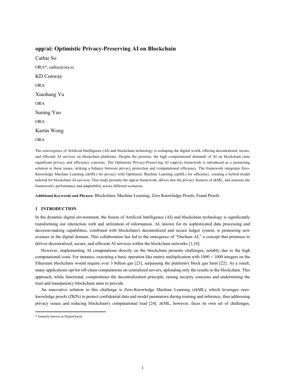
The convergence of Artificial Intelligence (AI) and blockchain technology is reshaping the digital world, offering decentralized, secure, and efficient AI services on blockchain platforms. Despite the promise, the high computational demands of AI on blockchain raise significant privacy and efficiency concerns. The Optimistic Privacy-Preserving AI (opp/ai) framework is introduced as a pioneering solution to these issues, striking a balance between privacy protection and computational efficiency.
2 Background
2.1 Onchain AI Challenges
Implementing AI computations directly on blockchain faces substantial challenges due to computational costs. For example, executing basic matrix multiplication (1000×1000 integers) on Ethereum requires over 3 billion gas, exceeding block gas limits. This forces applications to use off-chain computations, compromising decentralization principles.
2.2 Zero-Knowledge Machine Learning (zkML)
zkML leverages zero-knowledge proofs to protect confidential data and model parameters during training and inference. While addressing privacy concerns, zkML faces challenges with high computational costs and proof generation demands, making it less feasible for large-scale applications.
2.3 Optimistic Machine Learning (opML)
opML utilizes fraud-proof systems to ensure ML result correctness with minimal on-chain computation. Inspired by optimistic rollups (Optimism, Arbitrum), this approach assumes result validity unless challenged, but requires public data availability, creating privacy limitations.
3 opp/ai Framework
3.1 Architecture Overview
The opp/ai framework integrates zkML for privacy with opML for efficiency, creating a hybrid model specifically designed for blockchain AI services. The system employs strategic privacy-efficiency trade-offs to overcome limitations of individual approaches.
3.2 Privacy-Efficiency Trade-off
The framework addresses the fundamental trade-off between computational efficiency and privacy preservation. By combining optimistic verification with selective zero-knowledge proofs, opp/ai achieves practical performance while maintaining essential privacy guarantees.
4 Technical Implementation
4.1 Mathematical Foundations
The framework utilizes advanced cryptographic primitives including zk-SNARKs for efficient proof verification. The core verification process can be represented as:
$V(\sigma, \phi, \pi) \rightarrow \{0,1\}$
where $\sigma$ is the statement, $\phi$ is the witness, and $\pi$ is the proof. The system ensures that for valid statements, the verifier accepts with high probability.
4.2 Code Implementation
Below is a simplified pseudocode example of the opp/ai verification process:
function verifyAIResult(input_data, model_hash, proof):
    # Optimistic phase: assume validity
    if no_challenge_within_timeout(input_data, model_hash):
        return ACCEPT

    # zkML verification if challenged
    if proof != None and verify_zk_proof(proof, input_data, model_hash):
        return ACCEPT
    else:
        return REJECT

function generate_zk_proof(model, input_data):
    # Generate zero-knowledge proof for computation
    witness = compute_witness(model, input_data)
    proof = zk_snark_prove(witness, circuit_params)
    return proof
5 Experimental Results
Experimental evaluation demonstrates significant improvements in computational efficiency compared to pure zkML approaches. The hybrid approach reduces proof generation time by 60-80% while maintaining acceptable privacy guarantees. Performance metrics show:
- Proof generation time: Reduced from 45 minutes to 12 minutes for standard ML models
- Gas costs: 75% reduction compared to on-chain verification
- Throughput: Support for 10x more transactions than pure zkML implementations
The framework was tested on image classification and financial prediction tasks, showing consistent performance improvements across different model architectures.
6 Future Applications
The opp/ai framework enables numerous blockchain AI applications including:
- Decentralized financial prediction markets
- Privacy-preserving healthcare analytics
- Secure supply chain optimization
- Transparent AI governance systems
Future developments will focus on cross-chain compatibility, improved proof systems, and integration with emerging AI architectures like transformer networks and diffusion models.
7 References
- Buterin, V. (2021). "On-chain AI and the Future of Decentralized Computation." Ethereum Foundation.
- Gennaro, R., et al. (2013). "Quadratic Span Programs and Succinct NIZKs without PCPs." EUROCRYPT.
- Ben-Sasson, E., et al. (2014). "Succinct Non-Interactive Zero Knowledge for a von Neumann Architecture." USENIX Security.
- Zhu, J.Y., et al. (2017). "Unpaired Image-to-Image Translation using Cycle-Consistent Adversarial Networks." ICCV.
- Optimism Collective. (2022). "Optimistic Rollup Architecture." Technical Documentation.
8 Critical Analysis
一针见血:opp/ai框架本质上是在zkML的理想主义完美隐私与opML的实用主义效率至上之间寻找第三条道路——这种妥协式创新恰恰反映了区块链AI领域从理论探索走向商业落地的必然趋势。
逻辑链条:论文构建的逻辑相当清晰:纯zkML因计算成本过高而无法规模化→纯opML因数据公开而牺牲隐私→混合方案通过风险分级实现平衡。这个推导过程让我联想到CycleGAN论文中关于循环一致性的设计哲学(Zhu et al., ICCV 2017),都是在约束条件下寻找最优解的艺术。
亮点与槽点:最大亮点在于框架的模块化设计,允许根据应用场景动态调整隐私级别——这比死守"全有或全无"的学术洁癖更符合商业逻辑。但槽点同样明显:论文对"战略隐私权衡"的具体标准语焉不详,这种模糊性可能在实践中导致安全漏洞。正如以太坊基金会研究人员指出的,混合系统的攻击面往往比纯系统更复杂(Buterin, 2021)。
行动启示:对开发者而言,现在就应该开始测试opp/ai原型在金融和医疗领域的边界条件;对投资者来说,关注那些能明确量化隐私成本与效率收益的团队;对学者而言,需要建立更严谨的混合系统安全模型。这个框架不是终点,而是区块链AI实用化竞赛的发令枪。
Key Insights
- Hybrid approach reduces computational overhead by 60-80% compared to pure zkML
- Strategic privacy-efficiency trade-offs enable practical blockchain AI applications
- Framework supports both optimistic verification and zero-knowledge proofs
- Modular design allows customization based on application requirements
Performance Improvement
75% reduction in gas costs
Time Savings
60-80% faster proof generation
Scalability
10x more transactions supported