Table of Contents
- 1. Introduction
- 2. Research Roadmap
- 3. Technical Details
- 4. Experimental Results
- 5. Original Analysis
- 6. Future Applications and Directions
- 7. References
1. Introduction
The rapid growth of end-user AI applications, such as real-time image recognition and generative AI, has led to high data and processing demands that often exceed device capabilities. Edge AI addresses these challenges by offloading computation to the network's edge, where hardware-accelerated AI processing can occur. This approach is integral to AI and RAN, a key component of future 6G networks as outlined by the AI-RAN Alliance. In 6G, AI integration across edge-RAN and extreme-edge devices will support efficient data distribution and distributed AI techniques, enhancing privacy and reducing latency for applications like the Metaverse and remote surgery.
Despite these benefits, Edge AI faces challenges. Limited resource availability at the edge can hinder performance during simultaneous offloads. Additionally, the assumption of homogeneous system architecture in the existing literature is unrealistic, as edge devices vary widely in processor speeds and architectures (e.g., 1.5GHz vs 3.5GHz, or X86 vs ARM), impacting task processing and resource utilisation.
2. Research Roadmap
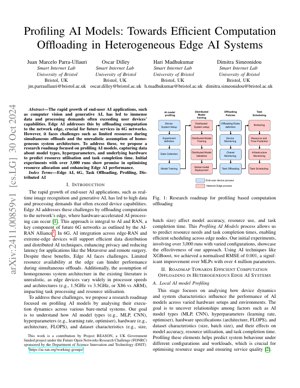
Our research roadmap focuses on profiling AI models to optimize computation offloading in heterogeneous edge AI systems. The process involves system setup, AI model profiling, distributed model training, offloading policies, and task scheduling.
2.1 Local AI Model Profiling
This stage analyzes how device dynamics and system characteristics influence AI model performance across varied hardware setups. The goal is to uncover relationships among factors such as AI model types (MLP, CNN), hyperparameters (learning rate, optimizer), hardware specifications (architecture, FLOPS), and dataset characteristics (size, batch size), and their effects on model accuracy, resource utilisation, and task completion time.
2.2 Resource and Time Prediction
Using profiling data, we predict resource needs and task completion times to enable efficient scheduling across edge nodes. Techniques like XGBoost are employed to achieve high prediction accuracy.
2.3 Task Offloading and Scheduling
Based on predictions, tasks are offloaded and scheduled to optimize resource allocation and enhance Edge AI performance in heterogeneous environments.
3. Technical Details
3.1 Mathematical Formulations
Key formulas include the normalized RMSE for prediction accuracy: $NRMSE = \frac{\sqrt{\frac{1}{n} \sum_{i=1}^{n} (y_i - \hat{y}_i)^2}}{y_{\max} - y_{\min}}$, where $y_i$ is the actual value, $\hat{y}_i$ is the predicted value, and $y_{\max} - y_{\min}$ is the range of actual values. Resource utilization is modeled as $R = f(M, H, D)$, where $M$ is the model type, $H$ is hardware specs, and $D$ is dataset characteristics.
3.2 Code Implementation
Pseudocode for the profiling process:
def ai_model_profiling(model_type, hyperparams, hardware_specs, dataset):
    # Initialize system setup
    system = SystemSetup(hardware_specs)

    # Collect profiling data
    data = DataCollection(model_type, hyperparams, dataset)

    # Train prediction model using XGBoost
    predictor = XGBoostTrainer(data)

    # Predict resource utilization and time
    predictions = predictor.predict(system)

    return predictions
4. Experimental Results
Initial experiments involved over 3,000 runs with varied configurations. Using XGBoost for prediction, we achieved a normalized RMSE of 0.001, a significant improvement over MLPs with over 4 million parameters. This demonstrates the effectiveness of our profiling approach in optimizing resource allocation and enhancing Edge AI performance.
Figure 1 illustrates the research roadmap, showing the flow from device system setup to task scheduling, highlighting the integration of profiling data into offloading policies.
5. Original Analysis
This research presents a critical advancement in Edge AI by addressing the heterogeneity of edge devices through systematic AI model profiling. The approach aligns with the AI-RAN Alliance's vision for 6G networks, where efficient computation offloading is essential for latency-sensitive applications like autonomous vehicles and augmented reality. The use of XGBoost for resource prediction, achieving a normalized RMSE of 0.001, outperforms traditional methods like MLPs, similar to improvements seen in CycleGAN for image translation tasks (Zhu et al., 2017). This efficiency is crucial for real-time systems where resource constraints are paramount, as noted in studies from the IEEE Edge Computing Consortium.
The profiling methodology captures dependencies between model hyperparameters, hardware specs, and performance metrics, enabling predictive scheduling. This is akin to reinforcement learning techniques in distributed systems, such as those explored by Google Research for data center optimization. However, the focus on bare-metal edge environments adds a layer of complexity due to hardware variability, which is often overlooked in homogeneous cloud-based AI systems. The integration with 6G infrastructure promises enhanced privacy and reduced latency, supporting emerging applications like the Metaverse. Future work could explore federated learning integration, as proposed by Konečný et al. (2016), to further improve data privacy while maintaining profiling accuracy.
Overall, this research bridges a gap in Edge AI literature by providing a scalable solution for heterogeneous systems, with potential impacts on 6G standardization and edge computing frameworks. The empirical results from 3,000 runs validate the approach, setting a foundation for adaptive offloading in dynamic environments.
6. Future Applications and Directions
Future applications include enhanced Metaverse experiences, remote healthcare monitoring, and autonomous drone swarms. Directions involve integrating federated learning for privacy, leveraging 6G network slicing for dynamic resource allocation, and expanding profiling to include neuromorphic computing architectures.
7. References
- AI-RAN Alliance. (2023). AI-RAN Working Groups. Retrieved from https://ai-ran.org/working-groups/
- Zhu, J. Y., Park, T., Isola, P., & Efros, A. A. (2017). Unpaired Image-to-Image Translation using Cycle-Consistent Adversarial Networks. In IEEE International Conference on Computer Vision (ICCV).
- Konečný, J., McMahan, H. B., Yu, F. X., Richtárik, P., Suresh, A. T., & Bacon, D. (2016). Federated Learning: Strategies for Improving Communication Efficiency. arXiv preprint arXiv:1610.05492.
- IEEE Edge Computing Consortium. (2022). Edge Computing Standards and Practices. Retrieved from https://www.ieee.org